Alliance Alert: Yesterday, Alliance staff delivered testimony at the New York State Mental Hygiene Joint Legislative Budget Hearing, continuing our push to advance the priorities we have heard consistently from members, partners, and communities across the state. As we emphasized in our testimony, we are pressing these priorities through every available avenue, including budget hearings, legislative meetings, public education, coalition advocacy, and direct action.
Our message at the hearing was clear: New York must shift its focus away from costly institutional expansions and toward community-based services that actually keep people well. We called for a 2.7% Targeted Inflationary Increase to stabilize the mental health and substance use workforce, sustained investment in housing and crisis response, continued implementation of Daniel’s Law initiatives with additional funding, protection of adult home advocacy programs, passage of key legislation, and a responsible plan to rightsize the state psychiatric hospital system and reinvest savings into the community.
While testimony is an important part of the process, it is not enough on its own. Decision-makers need to see and hear directly from the people most impacted.
That’s why next week is our biggest advocacy event of the year.
Join Us for Alliance’s Legislative Day, Next Tuesday, February 10
We urge everyone, people who use and seek services, family members, staff, peer workers, and provider agencies, to join us in Albany. Legislative Day is our opportunity to show the Governor and Legislature that these budget decisions have real consequences for real people.
Rally for the 2.7% Targeted Inflationary Increase
This rally is about more than numbers, it’s about people. It’s about the peer specialists, case managers, outreach workers, crisis responders, and other staff who show up every day, often underpaid and overstretched, to support New Yorkers in their most critical moments. It’s about ensuring that mental health and substance use services remain accessible, effective, and grounded in dignity and recovery.
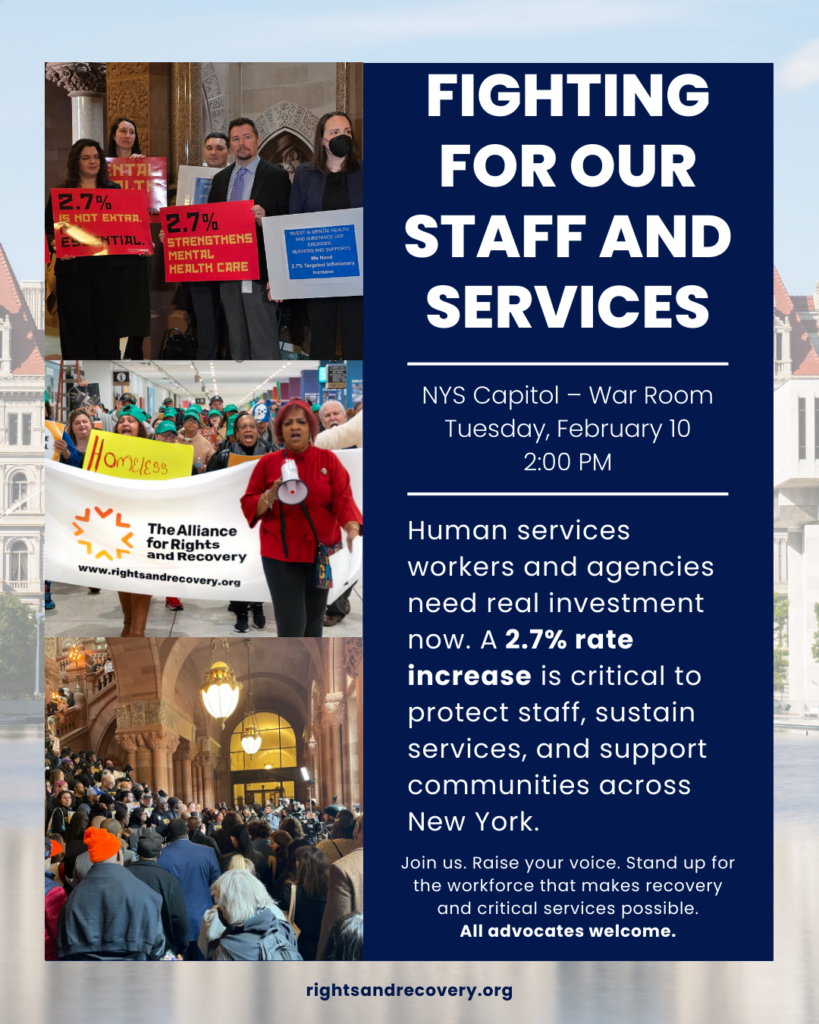
Get on the Free Bus: Transportation for February 10th Legislative Day
FULL BUS Brooklyn: https://forms.gle/5nKrc5iQfrn9fDsJ7
Buffalo: https://forms.gle/TXEbtrihFxA8R5f18
Hells Kitchen: https://forms.gle/N9cwVtaNAwMYaZc89
Hudson Valley: https://forms.gle/mWCLvzehfm2D6KGYA
Long Island: Long Island Bus Registration
North Country: https://forms.gle/iNDtssZpCyRPgCDu6
Queens: https://forms.gle/G78LHE5vK276733c7
Rochester: https://forms.gle/Q6kRNZ48jRnu3eEY7
Syracuse-Binghamton: https://forms.gle/ebkP6kPQcSTjdnZc7
Union Square: https://forms.gle/x4Ns2vj15XwgapFR9
Be there. Be heard.
Fight for our staff. Fight for our services.
Demand a 2.7% Targeted Inflationary Increase.
See the Alliance’s full budget testimony below:

Testimony for NYS Mental Hygiene Budget Hearing
February 4, 2026
Good morning. Thank you for the opportunity to submit testimony on behalf of the tens of thousands of New Yorkers living with major mental health, substance use, and trauma-related challenges who, in partnership with 85 community recovery agencies from across New York, work each day to advance their rights, recovery, and community inclusion.
Over the past 4 decades, our Alliance for Rights and Recovery has worked in close partnership with the legislature to increase funding for vital recovery and peer support services, increase access to essential housing, transportation and social supports, fight for social justice and racial and gender equity and, above all, protect and promote the dignity and rights of our community members.
I’m Luke Sikinyi, the Alliance’s Vice President for Public Policy and the testimony I’m providing here today represents the stated priorities that CEO Harvey Rosenthal and I have heard at the 14 regional and statewide events we’ve held in every corner of our state.
Before I get into our specific requests, I want to highlight the one theme we heard at every event: while Governor Hochul has been making an unprecedented investment in mental health services, far too much focus and far too any dollars have been and will be spent on both state and community psychiatric hospitals or beds, according to the Executive Budget proposal.
Most recently, the State announced $43 million for psychiatric services, including $20 million dedicated solely to increasing inpatient bed capacity in state and community hospitals and $23 million to expand Certified Psychiatric Emergency Programs. This comes on top of major hospital investments in recent enacted budgets. In the FY 2024–25 enacted budget, the State allocated $55 million to open 200 additional state-operated inpatient psychiatric beds, along with 75 Transition to Home Unit beds and pushing community hospitals to open over 700 more beds, continuing an approach that prioritizes institutional capacity over the community-based services that keep people well and out of crisis. In last year’s FY 2025–26 enacted budget, the State also advanced costly hospital-centered expansions, including the creation of another state psychiatric facility, even as community services and the workforce remain under-resourced.
Advocates are deeply frustrated that tens of millions and, in some cases, hundreds of millions of dollars continue to flow into inpatient and institutional services, when these same dollars could be used far more effectively to support prevention, early engagement, peer support, crisis response, rehabilitation, housing, treatment, and re-entry services that help people stay well in the community. We cannot build a recovery-oriented system by repeatedly expanding the most expensive and restrictive parts of the continuum while starving the services that people actually want and need. This direction also reinforces an overreliance on hospitals as the default solution, rather than investing in the community infrastructure that prevents avoidable hospitalization in the first place. See below about our thoughts on state hospitals and our call for a commission to study state hospital consolidation and reinvestment.
Workforce Stability, Housing, and Medicaid Managed Care Reform
We join other statewide advocates in calling for a 2.7 percent Targeted Inflationary Increase to stabilize the mental health and substance use workforce, while also standing with housing advocates in urging continued investment in existing and new supportive housing programs. These priorities are deeply connected. Without adequate staffing, services cannot operate; without housing, recovery cannot be sustained.
We also strongly support carving behavioral health services out of Medicaid managed care, which has created unnecessary administrative barriers, delayed or denied services, and failed to pay providers for services already delivered. The cost savings associated with a carve-out could be reinvested directly into frontline services, help address the needed inflationary increase, and strengthen community-based services instead of being lost to bureaucracy.
Together, workforce investment, housing stability, and managed care reform could form the backbone of an effective and fiscally responsible behavioral health system.
Daniel’s Law, the Behavioral Health Technical Assistance Center and a Connected Crisis Continuum
Last year, thanks to the leadership of Senator Brouk and Assemblymember Bronson and the support of the Legislature and Governor Hochul, the enacted budget included $8 million to support Daniel’s Law–style Mental Health First Responder pilots and the Behavioral Health Technical Assistance Center (BHTAC). This investment signaled an important commitment to building non-police, health-centered crisis response systems that connect people to support rather than subjecting them to criminalization or harm during moments of acute distress.
That commitment is critical because we know the stakes could not be higher. Too often, police-led responses to behavioral health crises result in escalation, injury, trauma, arrest, or death. These outcomes harm individuals and families, traumatize communities, and place officers in roles they are not trained or equipped to fulfill. Programs developed under Daniel’s Law reduce these risks by ensuring that people in crisis are met first by trained behavioral health professionals, peers, and emergency responders whose primary goal is safety, stabilization, and connection to services. This is not a place where the State can afford to gamble. The cost of failure is measured in lives, trust, and long-term system damage.
However, the way these pilots are currently funded threatens their long-term viability. Because the State’s investment was one-time funding, the Office of Mental Health was forced to stretch approximately $6 million across three years in order to keep pilot programs operating. While this approach allowed programs to launch, it will limit their ability to fully staff teams, expand coverage, invest in training, and plan for long-term sustainability. It has also created uncertainty for counties that are being asked to build new crisis response infrastructure without assurance that state support will continue once the initial funding period ends.
Counties are already facing significant fiscal pressure and simply do not have the capacity to absorb these programs when state funding sunsets. Without predictable, multi-year investment, local governments will be forced to scale back or eliminate programs that are demonstrably reducing harmful outcomes and improving crisis response. That instability undermines workforce retention, weakens partnerships, and prevents programs from becoming the robust, effective alternatives to police response that Daniel’s Law envisioned.
For these reasons, we strongly urge the State to invest an additional $8 million annually over the next five years to stabilize and expand Daniel’s Law initiatives and the BHTAC. Multi-year funding will allow programs to retain and train staff, expand geographic reach, integrate with existing crisis and community-based services, and collect meaningful outcome data. It will also give counties the confidence they need to sustain these critically important services during a time of shrinking local resources.
With sustained investment, Daniel’s Law programs can grow from pilots into permanent, statewide components of New York’s crisis continuum, connecting and strengthening the many initiatives supported in prior budgets. This is how the State can reduce harm, avoid tragic outcomes associated with police-led responses, and ensure that people experiencing crisis receive dignity and support when they need it most.
Adult Home Advocacy and Resident Council Programs
The budget includes a $230,000 cut to Adult Home Advocacy and Adult Home Resident Council Programs that provide essential rights education, legal advocacy, leadership development, and collective organizing support for adult home residents, many of whom live with major mental and physical healthcare challenges and rely on state support to succeed in their local communities.
The Legal Advocacy Services have been critical to ensuring that residents’ basic rights to receive appropriate services from adult home operators are upheld and the Resident Councils empower individuals to raise concerns, address unsafe conditions, and advocate for quality-of-life improvements.
Without this modest but critical funding, residents would lose one of the only avenues for independent advocacy and collective voice, increasing the risk of isolation, neglect, and rights violations in adult home facilities. Up until now, the residents have been able to count on their support and that of the Justice Center to advocate for their human rights, basic needs and social justice.
This is not the place or time for the state to make cuts to these essential and hugely cost-effective initiatives that give encouragement and trusted and reliable support to people who, in the wake of new federal policies, are very frightened that they will not have the support and advocacy they need to maintain their mental and physical health and success in living in the community.
Treatment Court Expansion Act (A.4869 / S.4547),
We strongly urge passage of the Treatment Court Expansion Act (A.4869/ S.4547), which would expand access to treatment courts for people with mental health and substance use challenges and reduce unnecessary incarceration. Under current law, too many New Yorkers are excluded from diversion and instead cycle through jails and courts without access to timely treatment. These, along with our other priorities strengthen voluntary, community-based alternatives and promote long-term stability.
Forensic Rehabilitation Act (S.8310/A.8603)
We also strongly support passage of the Forensic Rehabilitation Act, which would reduce unnecessary and prolonged forensic confinement by ensuring clinical decision-making, rather than prosecutorial discretion, determines placement and length of stay. The Act creates clearer, timelier pathways back to the community with appropriate supports, improves outcomes, and reduces costly institutionalization while enhancing public safety.
Raise the Age
We are grateful that the Governor made no changes to this landmark initiative and continue to work to see effective implementation of the program.
Rightsizing the State Psychiatric Hospital System
According to the Executive Budget, the Office of Mental Health operates two Research Institutes and 22 state psychiatric centers, providing more than 4,057 inpatient beds for adult, child, youth, and forensic populations. This means that New York maintains more state psychiatric hospitals than the nation’s two most populous states combined: California (5) and Texas (13). This number of institutions is not only out of step with modern, evidence-based mental health services, it represents a staggering misuse of public dollars. Every year, New Yorkers pour billions into maintaining an oversized and outdated hospital system while people across the state struggle to access housing, crisis services, peer support, and community-based support that actually prevents hospitalization. These funds could and should be reinvested into proven, cost-effective community supports that promote recovery, reduce reliance on institutionalization, and deliver far better outcomes for individuals, families, and taxpayers alike.
Accordingly, we join our friends at MHANYS in calling for the creation of a State Psychiatric Hospital Rightsizing Commission to evaluate how New York can more effectively use its resources through smart consolidation or closure of state psychiatric centers with persistently low censuses. This is not about eliminating needed beds, but about aligning capacity with actual need and shifting resources to where most people receive services, in the community.
New York has successfully done this before, closing or downsizing state hospitals and reinvesting savings into community-based services that have allowed thousands of people to live and recover outside institutions.
Similar authority has recently been granted to close prisons and reinvest funds into prevention and community safety. A thoughtful, transparent rightsizing process would allow the state to reinvest savings into housing, crisis services, peer support, and step-down options that help people avoid hospitalization and return to their communities sooner.
Self-Directed Care: Sustaining and Expanding a Vital Innovation
Self-Directed Care is a person-centered service model that allows individuals to control their own service budgets, choose the supports that best meet their needs, and define their own recovery goals. Rather than fitting people into rigid program structures, Self-Directed Care recognizes that recovery looks different for everyone and that people are experts in their own lives. Participants use individualized budgets to access a wide range of supports, including peer support, housing-related assistance, wellness activities, transportation, education, and culturally responsive services that are often unavailable through traditional systems.
New York’s Self-Directed Care pilots have demonstrated strong outcomes, including increased engagement, reduced crisis service use, and greater stability and satisfaction among participants. It is critical that the State build on existing initiatives to expand access to Self-Directed Care as a core component of New York’s mental health system, ensuring that individuals who benefit from this approach are able to continue receiving these supports and that more New Yorkers can access this proven, recovery-oriented model.
Closing
New York has the opportunity to build on what works by investing in people, communities, and systems that prioritize recovery over crisis. We look forward to working with the Legislature and the Administration to advance these priorities and thank you for your leadership and attention.
Thank you,
Luke Sikinyi
Vice President of Public Policy
Harvey Rosenthal CEO
Alliance for Rights and Recovery
Lukes@rightsandrecovery.org
518-703-0264