Alliance Alert: Criminal justice reform continues to be a central priority for the Alliance for Rights and Recovery, and recent developments highlight both the urgency and complexity of this work. From ongoing debates around solitary confinement under the HALT Act to uncertainty about the future of New York City’s B-HEARD crisis response program, these issues underscore the need for thoughtful, community-based approaches that prioritize safety, dignity, and recovery.
We remain deeply concerned about efforts to roll back protections like the HALT Act, which was designed to reduce the harmful use of solitary confinement, as well as delays in improving crisis response models like B-HEARD that aim to connect people in crisis with trained mental health professionals instead of law enforcement. These are not isolated issues, they are part of a broader conversation about how we respond to people in crisis and how we build a system rooted in compassion rather than punishment.
As part of this ongoing work, we invite you to join us today at 12:00 PM for a webinar with the Correctional Association of New York (CANY), where we will hear directly about prison conditions, oversight efforts, and opportunities for reform across the system. Register here: Oversight in Action, Register Today!
These issues, and many others at the intersection of mental health and the criminal justice system, will also be explored at the Alliance’s upcoming Executive Seminar. We strongly encourage leaders, providers, and advocates to register and attend to learn more about the policy landscape, engage in critical conversations, and identify opportunities to advocate for meaningful reform.
Register Today:
2026 Alliance for Rights and Recovery Executive Seminar Tickets, Thursday, Apr 16 from 9 am to 4 pm | Eventbrite
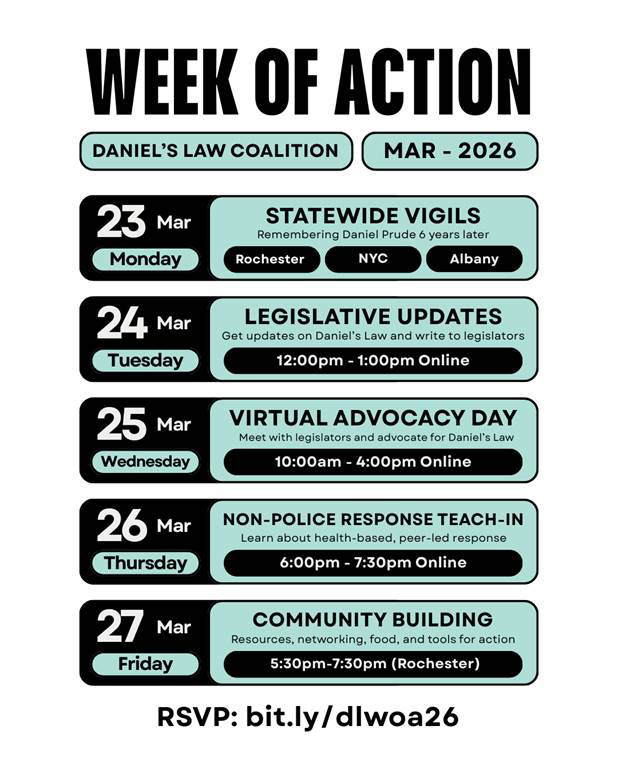
Next week also marks Daniel’s Law Week of Action, held each year during the week of March 23rd to honor Daniel Prude and continue the fight for a crisis response system that is led by trained mental health peers and EMTs. We encourage all members and partners to participate in Week of Action events and help push forward the vision of a safer, more effective, and more humane response to crisis.
Together, through advocacy, education, and collective action, we can continue to push for a system that centers recovery, rights, and community-based solutions.
GOP Lawmakers Push for Changes to NY’s Solitary Confinement Law“
By Brendan J. Lyons, Albany Times Union March 16, 2026
ALBANY — Republicans in the state Assembly on Monday called on the governor and Democrats who control the Legislature to adopt at least some of the recommendation of a committee that was formed in the wake of last year’s state prison strike and had suggested several changes to the statute governing the use of solitary confinement.
“The least we should do is implement the recommendations made by the people who know the prison system better than anyone, and whose lives are impacted more than anyone,” Assembly Minority Leader Ed Ra said. “We’ve said it time and time again, and I’ll say it again here: if our correction officers aren’t safe, nobody in those facilities is safe.”
Although Republicans stand little chance of advancing legislation in the Assembly, they often propose bills as a way of initiating conversations and debate about matters that affect New Yorkers. In this case, they would need to convince a Democratic lawmaker to agree to sponsor their own version of the bill, or to at least adopt parts of it.
But the operation of New York’s prisons is an issue that often breaks along partisan lines in the Legislature, where Democrats have called for sharply reducing the use of solitary confinement and Republicans — as well as corrections officials — have said the inability to segregate inmates who engage in violence is leading to more dangerous conditions for both employees and those who are incarcerated.
In September, the Department of Corrections and Community Supervision announced the proposed amendments that were recommended by the committee that was formed last year to review the statute, known as the Humane Alternatives to Long-Term Solitary Confinement Act, or “HALT” Act, which went into effect in March 2022.
The committee’s recommendations included giving the corrections department the flexibility to place an inmate in segregation for up to 15 days for “recidivist misconduct” when they are in the prison’s general population. The panel suggested three incidents within a 30-day period could trigger that provision, which they said would be invoked “in cases where it has been determined that alternative interventions have failed, and the ongoing misbehavior creates an unreasonable risk to safety or disruption to the operation of the facility.”
Many of the other amendments, which would need to be approved by the Legislature and signed by the governor to change the statute, also recommend provisions that would give correction officers more discretion to segregate an inmate in solitary confinement.
Advocacy organizations, including the New York Civil Liberties Union, condemned the proposed rollbacks and asserted that any solitary confinement amounts to inhumane torture.
The committee’s recommendations were sent to Gov. Kathy Hochul’s office for review last year. Ra, who was appointed minority leader last month, noted that during Hochul’s State of the State address in January, she made “no mention of these recommendations that had come from a committee that they had set up, that she had two agency heads on.”
Leaders of one of the unions representing correction officers joined Assembly Republicans at Monday’s news conference at the Capitol, asserting that conditions in state prisons have deteriorated so badly that the number of officers quitting or retiring is outpacing recruitment efforts. The staffing situation was exacerbated last year by an unsanctioned strike by correction officers — a walkout that depleted their ranks after many officers were later fired for refusing to return to duty. It’s led to National Guard troops being deployed in state prisons for more than a year.
The 2022 law had limited the ability of the corrections department to place an inmate in solitary confinement for offenses such as sexual harassment, lewd conduct, throwing bodily fluids or the contents of a toilet bowl onto staff, extortion, rioting or an escape attempt.
In response, the committee recommended including many of those offenses as conduct that would allow officers to place a person in solitary or segregated confinement.
Bernadette Rabuy, policy counsel at the NYCLU, said that the department “is not a lawmaker, and the agency cannot just defy a law it doesn’t like and has steadfastly refused to implement.”
Last year, corrections Commissioner Daniel F. Martuscello III acknowledged the recommendations could not be implemented until they are approved by the Legislature and governor.
“It is my hope that the Legislature considers these changes as an important evolution of the HALT Act that reflects all we have learned since its inception in March 2022,” the commissioner said at the time.
The NYCLU has countered that the committee that reviewed the solitary confinement law was comprised entirely of what they said are opponents of the HALT Act. The members representatives of the corrections department, several unions whose members work in state prisons, the governor’s Office of Employee Relations and the state Division of Criminal Justice Services.
The Legal Aid Society released a similar condemnation of the proposed revisions last year, casting them as an “effort to undermine HALT’s crucial and hard-won limits on solitary” and calling for them to be rejected.
Many advocacy organizations have filed lawsuits over the past three years against the corrections department for allegedly failing to fully implement the provisions of the solitary confinement law. But corrections officials have said that many of those decisions — including limiting out-of-cell time for mentally ill inmates — have been driven by the ongoing staffing crisis.
The New York State Correctional Officers & Police Benevolent Association was rebuffed last year when the union urged state lawmakers to amend the HALT Act that they said severely limits, and in some instances eliminates, the reasons that inmates may be placed in special housing units and separated from the general population of prisons and jails.
GOP lawmakers push for changes to NY’s solitary confinement law
B-HEARD overhaul on ice as Mamdani mulls direction
By Ethan Geringer-Sameth | Crain’s Health Pulse | March 17, 2026
As Mayor Zohran Mamdani faces pressure to improve the city’s mental health crisis response, an overhaul of the city’s beleaguered 911-based program unveiled in the final days of the Adams administration has not moved forward.
New York City Health and Hospitals, the public hospital system Adams tapped to take over the B-HEARD program, has yet to act on the proposal and its budget still reflects the prior status quo, President and CEO Dr. Mitchell Katz told lawmakers at a City Council budget hearing on Monday.
Asked about the timeline for implementing the change, which was originally set for spring, Katz couldn’t confirm that it would take place at all because the Mamdani administration has not decided on the program’s direction.
“We’re currently awaiting this decision on whether that’s going to happen or we’re going to choose one of the other hybrid models,” he said, referring to a set of hypothetical alternatives that the mayor has not publicly opined on.
“The new administration is looking at it. I think they and the fire chief, everybody understands what the city’s goal is and it’s just a question of choosing a model,” Katz said.
Launched in 2021 after a several high-profile police shootings, B-HEARD diverts some 911 calls to a team of EMTs and social workers trained to respond to mental health crises. The system has been beset by challenges including an EMT shortage in the Fire Department that has slowed response times and limited the program’s reach. In November, Adams unveiled a plan to fully fund and operate B-HEARD through Health and Hospitals and reassign the Fire Department’s EMTs. The new model, which would use the public hospital system’s social workers, nurses and ambulance drivers, would eliminate the dependence on FDNY EMTs, said Katz.
Katz demurred when asked to take a position on the plan but said the health system was ready to implement it, though it wasn’t included in Mamdani’s preliminary budget.
“Our common goal should be to get the social worker to these calls and that is not happening under the current arrangement,” he said. “And I will support any arrangement that gets the social worker there.”
Before taking office in November, Mamdani vowed to fix and expand the B-HEARD program as a central component of his mental health care agenda.
Under his plan, the program would be under the jurisdiction of a newly created Department of Community Safety, which he said would take over many mental health response and homeless outreach functions currently performed by the NYPD.
Mamdani has provided few details about how the new agency would operate and he did not include funding for it in his $127 billion preliminary budget, released in February.
The B-HEARD budget in Mamdani’s preliminary budget proposal is $24.5 million in the current fiscal year and $35.3 million next fiscal year, according to the Council’s Mental Health Chair, Mercedes Narcisse. Under that plan, Health and Hospitals would only pay for social workers in the program as is currently the case, Katz said. It does not include a budget for the EMTs and vehicles that H+H would also pay for under Adams’ plan.
City Hall declined to comment.