Alliance Alert: The Alliance for Rights and Recovery recognizes the creation of the Mayor’s Office of Community Safety as an important step in rethinking how New York City responds to mental health and substance use crises, but it is clear that much more must be done to fully transform our crisis response system across the city and state.
For far too long, New York has relied on a fragmented, under-resourced approach that too often defaults to law enforcement, even when a health focused, peer-led response would be more appropriate. While programs like B-HEARD represent progress, their limited scope and reach highlight the need for a comprehensive, statewide overhaul of crisis response, one that ensures people in crisis are met with compassion, not criminalization.
This is why the Alliance continues to strongly advocate for Daniel’s Law, as well as sustained funding for additional pilot programs and the Behavioral Health Crisis Technical Assistance Center (BHTAC). The BHTAC is especially critical, as it will help local communities assess their existing resources and build the infrastructure needed to move away from police as default responders and instead deploy non-police crisis teams, particularly peers and EMTs, who are trained to provide appropriate, compassionate support.
For those interested in learning more about these efforts, as well as broader statewide and national policy, funding, and service updates, we encourage you to register for the Alliance’s upcoming Executive Seminar, where you’ll hear directly from Alliance staff and representatives from the Office of Mental Health on what’s ahead and how you can stay engaged.
Register Today:
2026 Alliance for Rights and Recovery Executive Seminar Tickets, Thursday, Apr 16 from 9 am to 4 pm | Eventbrite
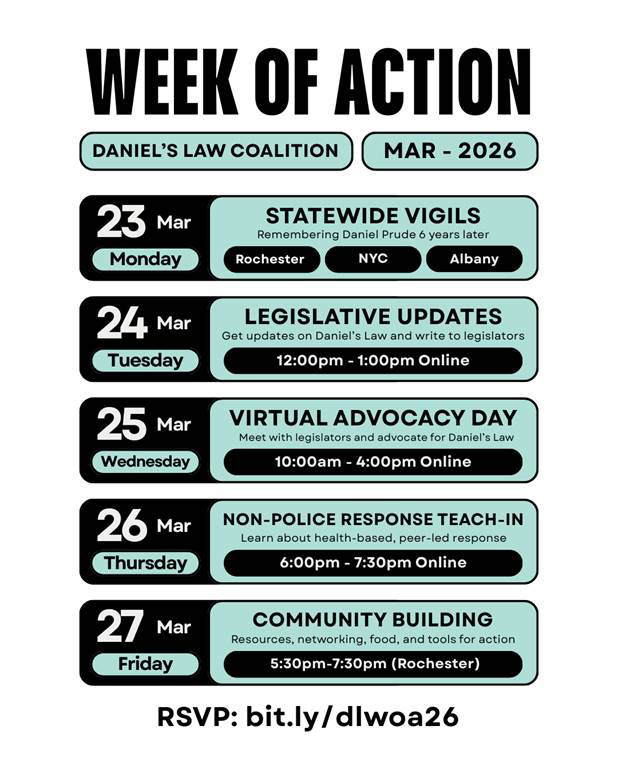
Next week also marks Daniel’s Law Week of Action, held each year during the week of March 23rd to honor Daniel Prude and continue the fight for a crisis response system that is led by trained mental health peers and EMTs. We encourage all members and partners to participate in Week of Action events and help push forward the vision of a safer, more effective, and more humane response to crisis.
Together, through advocacy, education, and collective action, we can continue to push for a system that centers recovery, rights, and community-based solutions.
Mamdani Scales Back Campaign Pledge with New Public Safety Office, not Agency
By Ethan Geringer-Sameth | Crain’s Health Care | March 19, 2026
Mayor Zohran Mamdani is launching a new mayoral office to take over several existing public safety and mental health functions, deferring a campaign promise to stand up a brand new city agency for the task.
Dubbed the Mayor’s Office of Community Safety, the program is a smaller-scaler version of one of the mayor’s signature proposals on the campaign trail: a new, independent department that would oversee many of the police activities associated with homelessness and mental health.
The new office will run the city’s 911 mental health response program, B-HEARD, and several offices currently housed in other city agencies such as the Department of Health and Mental Hygiene and the Department of Social Services.
Mamdani called the office “the first major step towards building the department of community safety” at a press conference in the City Hall rotunda on Thursday afternoon, saying the announcement “fulfills the change that more than 1 million New Yorkers voted for.”
“For too long, we have approached crime and safety by placing only ever-expanding expectations on the Police Department as we have asked them to address every failure of our social safety net,” he said. “Crime is one of the most complex issues we face, and yet our city’s approach for far too long has been to rely on a patchwork of programs to deal with interconnected problems.”
When seeking office, Mamdani billed the entity as a police alternative amid concerns that law enforcement was not equipped to respond to issues best addressed by social and clinical services. Notably, none of the functions under the new office will be coming from the New York Police Department, according to an organization chart reviewed by Crain’s.
The programs within the office will cost about $260 million, which is already accounted for in the mayor’s $127 billion preliminary budget proposal, according to City Hall spokesman Sam Raskin. The office will exist under a newly created Deputy Mayor for Community Safety who will oversee the office’s commissioner and report directly to the mayor. Mamdani tapped Renita Francois, a former nonprofit and city official, to take the role. Francios is the only Black deputy mayor in the administration and her appointment follows criticism of a lack of representation at the highest level of Mamdani’s cabinet.
The scope and scale of the new office, established through executive order on Thursday, is significantly more manageable than a whole new agency, which would likely require buy-in from the City Council and more than quadruple the funding. When campaigning last year, Mamdani said the department would have an annual budget of $1.1 billion, including $605 million from existing services, many of which are performed by the NYPD.
As a candidate, Mamdani gained attention for the plan early in the election cycle, and it helped differentiate him in a crowded field of progressive candidates and contrasted him against the more centrist former Gov. Andrew Cuomo. But the eye-catching proposal was always viewed as an uphill battle, entailing the politically arduous task of limiting the functions of the NYPD and its roughly $13 billion budget. At a City Council hearing on Wednesday, Police Commissioner Jessica Tisch told lawmakers her department would not be ceding any budget to a new agency.
Mamdani said the administration would push for more funding for the office in the next iteration of his budget proposal, which will be negotiated with the Council before it is adopted by June 30.
The mayor’s pitch, that the office is a first step to establishing an independent city agency down the line, follows the path of other agencies that have been born via that route. The Office of Emergency Management and Department of Homeless Services were both introduced as mayoral offices during the Dinkins administration in the 1990s before becoming stand-alone departments.
“It’s our responsibility, as the mayor said, to take these disparate programs and to create a cohesive strategy,” Francios said. “That’s not going to happen tomorrow if we want to do that thoughtfully and in a way that is sustainable.”
The announcement on Thursday was the first indication Mamdani has given as mayor about the future of the B-HEARD program. B-HEARD dispatches EMTs and social workers to some non-violent mental health 911 calls; however, the unit responds to only a fraction of eligible calls and has been criticized for its slow response times and limited resources.
On his way out of office last November, former Mayor Eric Adams said the program would be transferred to New York City Health and Hospitals, the city’s public hospital system, from the Fire Department, which has suffered from an EMT shortage. Health and Hospitals CEO Dr. Mitchell Katz, a holdover from the de Blasio administration who was part of discussions with Adams, acknowledged the logic of the plan at a Council hearing this week, noting that H+H employs many of the workers needed. Katz said the system was ready to follow through with Adams’ plan but added that he would support any model that improves the program.
The new office will also take over the Health Department’s Office of Community Mental Health and the Department of Social Services’ Office to End Domestic and Gender-Based Violence. And it will house the Office for the Prevention of Hate Crimes, currently run by the Mayor’s Office of Criminal Justice, and the Office of Neighborhood Safety, a gun violence prevention program in the Department of Youth and Community Development.