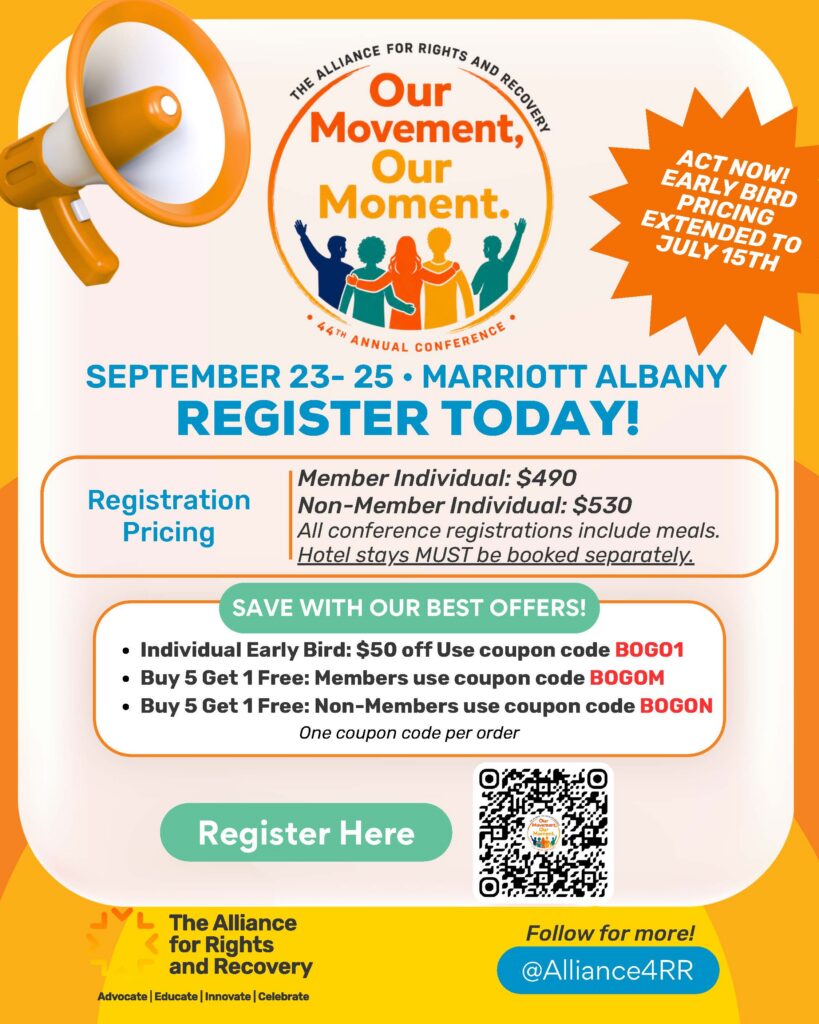
Register today and take advantage of our extended special
Buy 5, Get 1 Free group registration offer before it’s too late!
Alliance Alert: The growing demand at food pantries across New York is yet another reminder that nutrition is one of the most fundamental health-related social needs. As changes to SNAP take effect and more New Yorkers face the possibility of losing food assistance, we must ensure that people are not forced to choose between buying groceries, paying rent, accessing health care, or meeting other basic necessities. While food pantries and community organizations continue to do extraordinary work, they cannot replace the stability and reach of a strong nutrition assistance system.
The Alliance for Rights and Recovery remains committed to advancing health-related social needs services that recognize the critical connection between nutrition, housing, transportation, and overall health and recovery. The progress made through New York’s Medicaid waiver has demonstrated that addressing these basic needs leads to better health outcomes, reduces costly crises, and helps people remain connected to their communities. As federal policy changes create new barriers to nutrition assistance, states must continue investing in innovative approaches that connect people with the supports they need to live healthy, stable lives.
These issues will be front and center at the Alliance’s Annual Conference this September. Our workshop on federal and state policy changes will examine the latest developments affecting Medicaid, SNAP, and other critical support programs while exploring how advocates can work at both the state and national levels to strengthen protections, expand health-related social needs services, and ensure that every state has the tools and flexibility needed to support people facing food insecurity and other social challenges. At a time of significant policy change, advocacy has never been more important to protecting the health, rights, and recovery of our communities.
See below for the registration and hotel information. View the full conference program here or in the attachment.
*Due to popular demand, we’re extending our Buy Five, Get One Conference Registration offer through Friday, July 24 at 11:59 p.m. This is the final extension of this promotion and the last opportunity to take advantage of this special rate before regular pricing kicks in. We know many organizations are waiting to hear about conference scholarship awards, which will be announced soon. We strongly encourage you to secure your registrations now with confidence: if someone you register is later awarded a scholarship, we’ll gladly transfer that paid registration to another individual from your organization. Don’t miss this final opportunity to register your team and join us for this year’s Alliance Annual Conference!
Register for Conference HERE
Get Hotel Rooms HERE
Full Conference Program
Food Pantries See Long Summer Lines as New Yorkers Lose SNAP Benefits in Trump Overhaul
By Karen Yi | Gothamist | July 15, 2026
The line outside a South Bronx food pantry snaked down the block, across the avenue and down two more blocks on a recent summer day. People began lining up as early as 5 a.m., even though the pantry doesn’t open until 10 a.m.
Food pantries across New York City say they’re already seeing an increase in demand as schools that offer free meals close for the summer and gas prices remain stubbornly high. They say they have enough food for now but worry they’ll run out of supplies once more New Yorkers begin losing their benefits under the Trump administration’s changes to the Supplemental Nutrition Assistance Program.
“Demand’s always going to be here, because with the cost of everything going high, food especially, and then with gas, whenever gas goes up, especially in summertime, prices go up,” said Christian Estrada, who runs the pantry and is the food services director for United Bronx Parents, an affiliate of the Acacia Network.
Congressional Republicans and President Donald Trump overhauled SNAP last summer. More expansive work rules took effect in New York earlier this year, requiring SNAP recipients between 18 and 64 years old to prove they are working, volunteering or in school in order to keep their benefits. People with a documented disability or medical condition can be exempt from the rules.
City officials haven’t said how many New Yorkers were cut off their SNAP benefits last month as part of the first wave of shutoffs expected under the new work rules. But they have warned that as many as 42,000 people — 40% of whom are men between 18-30 years old — are at risk.
In New Jersey, more than 31,000 people have had their SNAP benefits turned off since May, state officials said.
“ We haven’t seen the height of this just yet,” said Lakisha Morris, division director for food and housing stability at Catholic Charities. ”As the summer winds down and the fall begins, I think that’s when the impact is going to just spiral.”
She said food pantries can’t make up the gap for what SNAP provides and worried providers will have to make hard choices as more people come to their doors.
“That’s just disheartening to turn people away, especially if they’re standing on a line for hours waiting.”
No Kid Hungry New York released a poll earlier this year that found two-thirds of New Yorkers had to pick between buying enough nutritious food or paying other bills in the last year. An even higher rate of families with children, about three-quarters, were making those trade-offs, the poll said.
When Gothamist visited last month, Rameek Allah was the first on line outside the South Bronx pantry. He said he receives SNAP benefits but still visits several pantries to patch together enough food for the month.
“ I have a budget, so I work within my budget. I use my pantry to help me with whatever I don’t have,” Allah said. He said he wasn’t currently working and needed to file a medical exemption in order to keep his benefits under the new rules.
“ Cross my T’s, dot my I’s,” he said.
A report by the anti-poverty organization Robin Hood found SNAP recipients are more than three times as likely than New Yorkers not on SNAP to have a health condition or disability. Overall, the report also found SNAP reduces the poverty rate by more than 19% among recipients in the city.
Statewide, officials told Gothamist about 146,000 SNAP recipients were subject to the new work rules as of June. The rules took effect in March in the state and apply to individuals between 18 and 64 years old.
In the city, officials launched a door-knocking campaign and leveraged data to find people who would be exempt from meeting the new requirements because of a disability or medical condition.
Morris said service providers are also working to help New Yorkers navigate the new requirements. She said some clients are asking for more food at the pantries because they’re fearful they won’t be able to hold on to their benefits.
“ They have significant challenges to complying with this, whether it’s transportation to get to a program or an employment site, whether they still have kids that they need to tend to, it’s an extra burden when it comes to childcare,” she said.
Acacia Network said pantry visits at United Bronx Parents are up from last year and the two soup kitchens they run in the Longwood section of the Bronx also doubled the number of people they serve this year, compared to 2025.
Estrada said about 500 families come to the pantry that is open three days a week. He said more people will come depending on what the pantry has to offer that day — especially if there’s a protein.
“People communicate amongst each other when they’re passing by and we’re getting our trucks,” Estrada said. “They come and they start calling each other and the line gets big.”
The day Gothamist visited, the pantry handed out whole chickens, beverages, seaweed snacks, milk and yogurt. Estrada, who used to visit the pantry when he was a kid growing up down the block, said he tries to keep order — and doesn’t let anyone save spots on line — so there aren’t any fights and everybody can take some food home.
Librada Paulino receives SNAP but said it’s not enough to feed herself. She relies on the pantries to supplement basic items but also fill up on snacks that she doesn’t want to spend money on but sometimes craves.
“Sometimes you want something sweet or a yogurt, anything, sometimes you have a craving,” she said in Spanish.
WNYC and Gothamist are hosting a live event on July 21 from 6:30-8:30 p.m. to discuss food insecurity and changes to SNAP benefits. The event is part of WNYC’s “In Conversation” series focused on affordability. Join us at BEM Books at 373 Lewis Ave. in Brooklyn by registering for the free event here.
Food pantries see long summer lines as New Yorkers lose SNAP benefits in Trump overhaul – Gothamist