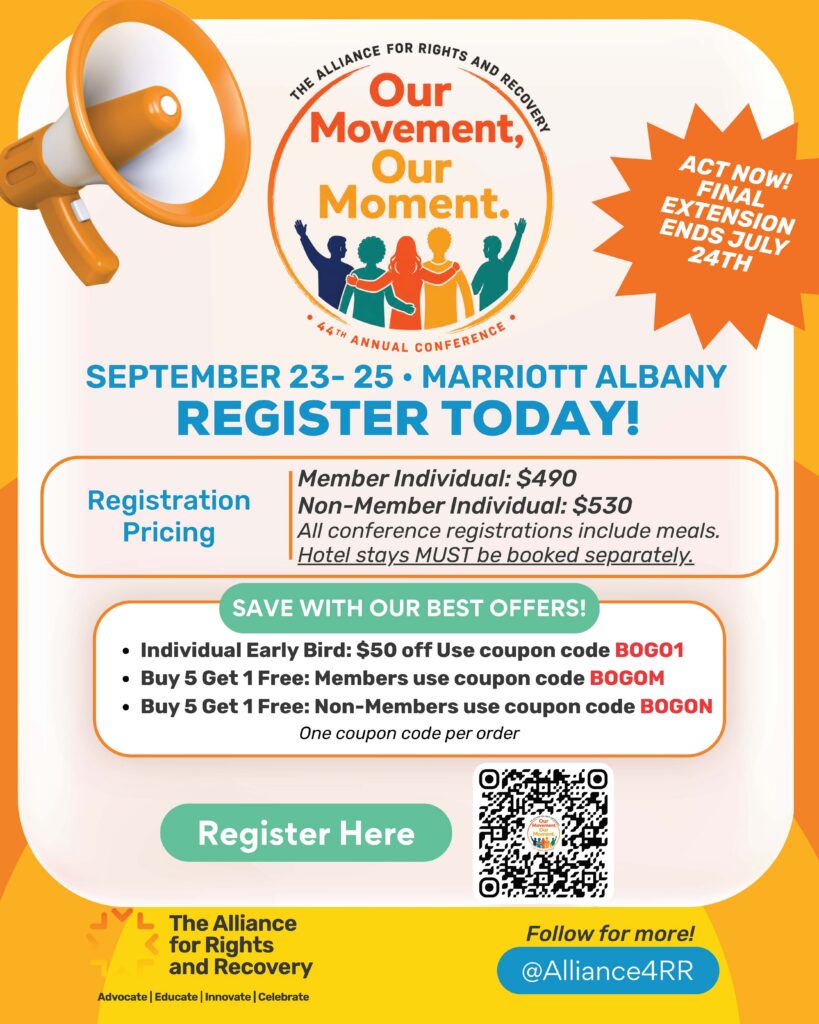
Register today and take advantage of our extended special Buy 5, Get 1 Free group registration offer by Friday (7/24)!
Alliance Alert: The Alliance for Rights and Recovery is deeply concerned by the U.S. Department of Justice’s continued efforts to move away from the integration mandate established by Olmstead v. L.C. and reinforced through decades of federal guidance and enforcement. For decades, the Olmstead decision has affirmed the fundamental right of people with disabilities to receive services in the most integrated setting appropriate to their needs, helping countless individuals live, work, and thrive in their own communities rather than being segregated in institutional settings. The recent decision to declare longstanding Olmstead guidance “not enforceable” represents another troubling step away from those protections and creates unnecessary uncertainty for states, providers, and, most importantly, people with disabilities.
The Alliance has been actively pushing back against the federal government’s retreat from the integration mandate and will continue fighting to ensure that New York and our nation do not move backwards toward policies that increase institutionalization and reduce opportunities for people to live independently in their communities of choice. We remain committed to advancing policies that strengthen community-based mental health, substance use, and disability services, expand housing and peer supports, and protect the civil rights of every individual to determine where and how they receive support. We will continue working alongside disability rights advocates, providers, policymakers, and people with lived experience to defend these hard-won rights and promote services that allow people to successfully live and thrive in their communities.
These critical federal policy changes will also be a major focus of the Alliance’s Annual Conference this September. Attendees will have the opportunity to hear from disability rights leaders from New York and across the nation during a panel dedicated to Olmstead, the integration mandate, and the future of disability rights. In addition, several conference sessions will examine recent federal policy changes affecting mental health, substance use, and disability services, providing advocates with the information and strategies needed to continue protecting community-based services and advancing the rights of people with disabilities.
See below for the registration and hotel information. View the full conference program here or in the attachment.
*Due to popular demand, we’re extending our Buy Five, Get One Conference Registration offer through Friday, July 24 at 11:59 p.m. This is the final extension of this promotion and the last opportunity to take advantage of this special rate before regular pricing kicks in. We know many organizations are waiting to hear about conference scholarship awards, which will be announced soon. We strongly encourage you to secure your registrations now with confidence: if someone you register is later awarded a scholarship, we’ll gladly transfer that paid registration to another individual from your organization. Don’t miss this final opportunity to register your team and join us for this year’s Alliance Annual Conference!
Register for Conference HERE
Get Hotel Rooms HERE
Full Conference Program
Justice Department Deems Major ADA Guidance ‘Not Enforceable’
By Michelle Diament | Disability Scoop | July 20, 2026
The Trump administration is tossing aside key guidance that federal officials have used to steer enforcement of the Americans with Disabilities Act for more than a decade.
The U.S. Department of Justice issued a notice Monday clarifying that its long-standing guidance on enforcement of the ADA’s integration mandate and Olmstead v. L.C. is “not enforceable.”
“The department will not rely upon the Olmstead guidance in its enforcement of Title II of the Americans with Disabilities Act,” reads the notice from Harmeet K. Dhillon, assistant attorney general for civil rights.
At issue is a Q&A document from 2011 that was last updated in 2020 which details implementation of the Supreme Court’s Olmstead decision. The 1999 ruling found that “states are required to provide community-based treatment for persons with mental disabilities” so long as certain conditions are met.
The guidance details what qualifies as the most integrated setting under the ADA and Olmstead, who should be able to access services in the community and much more. Subsequent Justice Department guidance on employment for people with disabilities and other related issues relied on the Olmstead guidance and the agency said this week that “similar guidance documents are not enforceable.”
Officials indicated that they plan to “revisit” the Olmstead guidance in light of a 2024 Supreme Court decision in Loper Bright Enterprises v. Raimondo on how courts should view agency guidance “to determine whether the Olmstead guidance is consistent with the ‘single, best meaning’ of the ADA.”
The Justice Department notes that the Q&A document itself indicates that it is not legally binding.
“Despite the non-enforceable nature of the Olmstead guidance, numerous courts have treated the Olmstead guidance as authoritative,” the Justice Department notice indicates. “The department is concerned about confusion over the non-enforceable nature of the Olmstead guidance and issues this clarification that the Olmstead guidance is not enforceable.”
The move to dissociate from the guidance comes roughly a month after the Justice Department’s Office of Legal Counsel issued a memo indicating that neither the ADA nor Section 504 of the Rehabilitation Act “require states to treat mentally disabled patients in the most integrated setting appropriate to their needs.” That stance runs counter to long-held interpretations of the Supreme Court’s Olmstead decision.
“The Department of Justice’s Olmstead guidance reflects the overwhelming consensus of courts in their interpretation of the requirements under the Americans with Disabilities Act and Section 504, their implementing regulations, and the Supreme Court’s decision in Olmstead v. L.C.,” said Alison Barkoff, a professor at George Washington University who oversaw development of the guidance when she served as the Justice Department’s special counsel for Olmstead enforcement. “Today’s notice from DOJ that it will no longer rely on the guidance is further evidence of their backing away from a decades-long commitment to enforcing the rights of people with disabilities to live and participate in their communities.”
Notably, the first Trump administration was responsible for the 2020 update to the Olmstead guidance that the Justice Department is now calling unenforceable, said Regan Rush, former chief of the special litigation section at the Justice Department’s Civil Rights Division who is currently tracking changes in the division’s policies as director and editor-in-chief of Red Line for Civil Rights at Democracy Forward.
“That guidance has stood the test of time. It is grounded in decisions by courts across the country and has been relied upon by states and the federal government alike since 2011,” Rush said. “States that follow DOJ’s cue and abandon their integration efforts risk violating the rights of people with disabilities, and they will have to answer for it in courts that have upheld Olmstead for decades.”
In the immediate, the Justice Department notice “is likely to create further uncertainty and confusion among stakeholders in the wake of DOJ’s June memo saying that there is no integration mandate,” said Jennifer Mathis, who served as deputy assistant attorney general for the agency’s Civil Rights Division under the Biden administration and is now deputy director at the Bazelon Center for Mental Health Law. “Neither of these things has the force of law, but they appear designed to undermine the rights of people with disabilities to live in their own homes and communities. The disability community will continue to fight these attacks on their hard won rights.”
The Justice Department did not respond to questions about the changes.
Justice Department Deems Major ADA Guidance ‘Not Enforceable’ – Disability Scoop