Alliance Alert: The Alliance for Rights and Recovery is joining disability rights advocates across the country in urging states to publicly reject the U.S. Department of Justice’s June 18, 2026 memorandum that attempts to walk away from the longstanding interpretation of Olmstead v. L.C. and the Americans with Disabilities Act’s integration mandate. A new Statement for States has been developed by leading disability rights organizations and legal advocates, including our friends at Bazelon Center for Mental Health Law, calling on governors and attorneys general to reaffirm their commitment to ensuring that people with disabilities have the opportunity to live, receive services, and fully participate in their own homes and communities, not in institutional settings.
The DOJ memorandum does not change the law. Olmstead remains the law of the land, and for nearly three decades courts have consistently recognized that unnecessary institutionalization violates the ADA. However, the federal government’s new position creates uncertainty at a time when states are facing significant budget pressures and difficult decisions about Medicaid and community-based services. The statement sends a clear message that states remain committed to protecting the civil rights of people with disabilities and continuing the progress made toward community integration over the past quarter century.
We encourage advocates, providers, people with lived experience, family members, and organizations across New York to help spread the word about this important effort. Please reach out to your networks, encourage state leaders to add New York’s name to this statement, and help ensure our state continues to stand firmly behind the principles of Olmstead. New York has long been a national leader in advancing community living, peer support, supportive housing, and person-centered services. Now is the time to reaffirm that commitment.
The Alliance will continue working alongside our partners across the disability rights community to defend the integration mandate and oppose efforts to weaken the rights of people with disabilities. We cannot allow decades of progress toward community living to be reversed. Every person deserves the opportunity to live, recover, and thrive in the community of their choice with the supports they need. See the full letter attached and read below for background information.
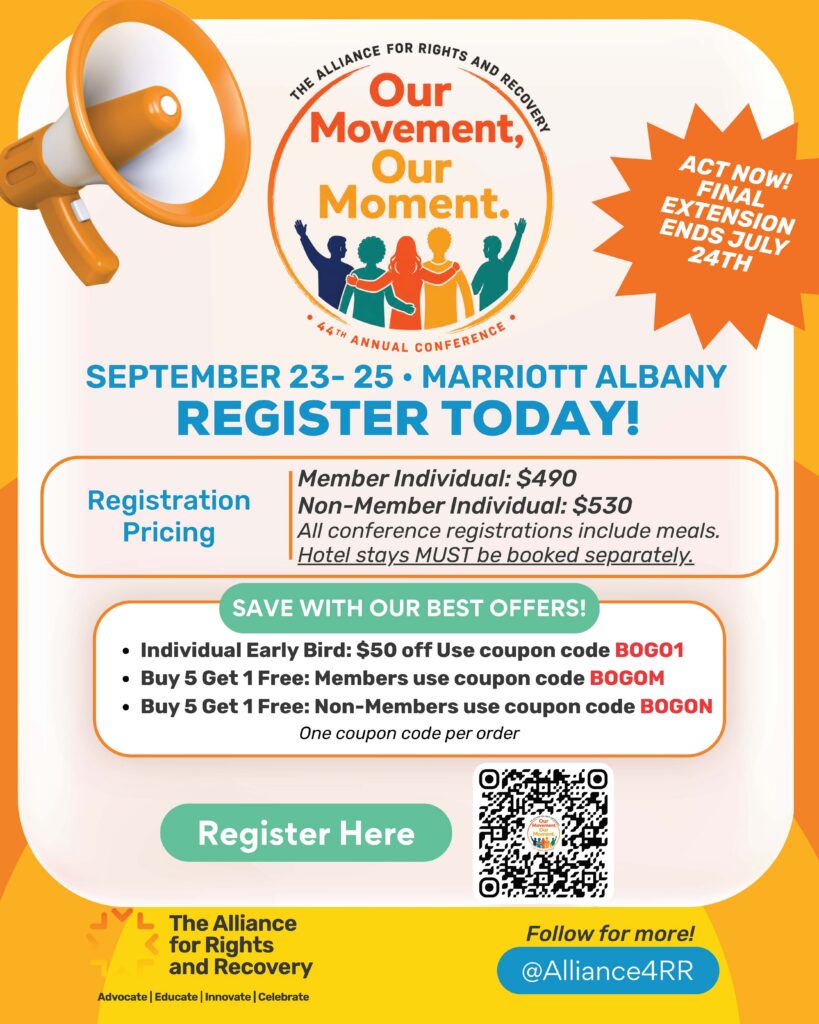
Continue the Conversation at the Alliance Annual Conference!
This critical issue will also be featured during the Alliance Annual Conference this September, where we are proud to host a panel on Olmstead and the future of disability rights featuring three nationally respected leaders:
- Clarence Sundram, one of the nation’s foremost disability rights advocates, former Chair of New York’s Commission on Quality of Care, and a nationally recognized expert on institutional reform and community integration who has spent decades monitoring and advancing the rights of people with disabilities.
- Jennifer Mathis, Deputy Director of the Bazelon Center for Mental Health Law and one of the country’s leading experts on Olmstead. She helped coordinate the disability community’s strategy before the U.S. Supreme Court in the Olmstead case and has spent her career litigating and advancing community integration rights.
- Patrick Wildes, Director of Albany Law School’s Government Law Center and former Assistant Secretary for Human Services and Mental Hygiene in the New York Governor’s Office, where he helped oversee state policy on mental health, addiction services, and historic investments in New York’s behavioral health system.
Don’t miss this important discussion about protecting one of the most significant disability rights decisions in our nation’s history and ensuring that community integration remains a reality for future generations.
Register today and take advantage of our extended special Buy 5, Get 1 Free group registration offer by Friday (7/24)!
Register for Conference HERE
Get Hotel Rooms HERE
Full Conference Program
Background on the Statement for States Rejecting DOJ’s June 18 Memo on Olmstead
On June 18, 2026, the Department of Justice’s (DOJ) Office of Legal Counsel issued a memo saying that federal disability rights laws do not give people the right to live in their own homes and communities. Specifically, the memo says that neither Title II of the Americans with Disabilities Act (ADA) nor Section 504 of the Rehabilitation Act require states to provide services to people with disabilities in the most integrated setting appropriate.
This memo flies in the face of decades of well-established law and the U.S. Supreme Court’s decision in Olmstead v. L.C. The DOJ’s new position is a complete reversal of the positions it has taken over the 27 years since the Olmstead decision.
Ask Your State to Reject the Memo
Among the things you can do is advocate with your state’s leadership to sign this statement, rejecting the new DOJ position and affirming that people with disabilities should be served in their own homes and communities.
Why is it Important for States to Sign the Statement?
The DOJ memo does not change the law. Only Congress can do that. But courts interpret the law. The memo invites states to rely on the DOJ’s new and incorrect legal view. If courts adopt the DOJ’s new view, that could dramatically narrow the rights of people with disabilities to live and receive services in their own homes and communities.
Further, the memo sends a dangerous message to states at a time when they are navigating reductions in federal Medicaid funding. Current budget shortfalls place home and community-based services at risk of being cut. The need to comply with the ADA, Section 504, and Olmstead has been a critical counter to the pressure to cut community services.
The DOJ Memo is Contrary to Fifty Years of Law
For nearly 50 years, federal law has required that states provide services to people with disabilities in the most integrated setting appropriate. This requirement has been in Section 504 regulations since 1977 and in the ADA Title II regulations since 1991.
In 1999, the U.S. Supreme Court affirmed in Olmstead v. L.C. that Title II of the ADA prohibits unjustified institutionalization of people with disabilities. Over the nearly 30 years since the Olmstead decision, courts have consistently interpreted the ADA and Section 504 to require states to provide services to people with disabilities in the most integrated setting appropriate. For decades, the federal government has enforced this requirement across both Republican and Democratic administrations.
The DOJ memo itself acknowledges that it is “out of step” with the courts. It says that the federal government will no longer serve as the lead enforcer of these rights. That makes it all the more important for states to step up and defend Olmstead and the integration requirement.
We Cannot Go Backward
Since the Olmstead decision, states have made significant changes in their service systems that support people with disabilities, expanding services that enable disabled adults and children to live full lives integrated in their communities—as neighbors, family, friends, coworkers, and classmates. While we have a long way to go before full compliance with Olmstead is achieved, we have made significant progress in serving people with disabilities in the community rather than in institutions. We cannot go backward.
Ask your state’s governor and attorney general to join this statement and reject the DOJ memo. States can join the statement by filling out this form.