
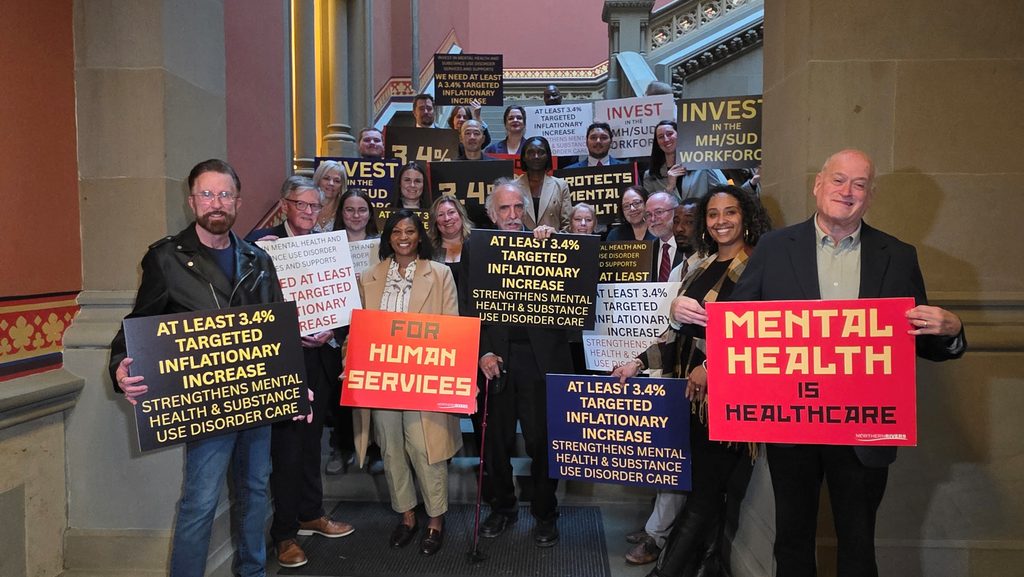
Alliance Alert: Yesterday, the Alliance for Rights and Recovery joined ten statewide behavioral health advocacy organizations, along with our member organization, the Mental Health Empowerment Project, at a press conference in Albany calling on Governor Hochul and the Legislature to make critical investments in New York’s mental health and substance use service workforce and community-based agencies.
Together, we are calling for a 3.4% Targeted Inflationary Increase (TII) in the upcoming state budget, tied to inflation in future years, and a new, dedicated, recurring Wage Investment to improve compensation, recruitment, and retention of the workers who provide essential services and supports to New Yorkers. These investments must go hand in hand to ensure that community-based agencies can keep their doors open, maintain and expand services, and retain the dedicated staff who make recovery possible.
Workforce investments are investments in recovery. Recovery is built through relationships, trust, and consistent support. For many people with mental health and substance use challenges, developing a trusting relationship with a peer supporter, counselor, case manager, or other community-based worker can take a long time. When those workers leave because they cannot afford to stay in their jobs, the people they support lose more than a service provider. They lose someone who understands their experiences, knows their goals, and has earned their trust. They may be forced to start over with someone new, repeatedly share painful or traumatic experiences, and rebuild relationships that were essential to their progress. These disruptions can retraumatize people, undermine their recovery, and cause them to disengage from services altogether.
We applaud Governor Hochul and the Legislature for their investments in community-based mental health and substance use services in recent years, including five consecutive years of inflationary increases. However, rising operating costs, longstanding funding gaps, and workforce shortages continue to threaten the stability of these programs. We must build on this progress with sustained investments that allow providers to retain experienced workers, strengthen services, and meet growing community needs.
New York cannot build a stronger, more effective, recovery-oriented system without investing in the people who deliver its services. Fair wages and stable funding are not simply workforce or agency priorities: they are essential to protecting continuity of services, preventing crises and hospitalizations, and helping people maintain their recovery in their communities.
The Alliance is proud to stand alongside our fellow advocates, providers, and people with lived experience in urging state leaders to make these investments a priority in the 2027–28 State Budget. By investing in our workforce and the agencies that employ them, New York can protect the relationships that support recovery and ensure that more people have access to the voluntary, community-based services they need to live healthy, fulfilling lives.
For Immediate Release
Contact: Glenn Liebman, CEO, MHANYS, 518-360-7916
October 20, 2026
PRESS RELEASE
Behavioral Health Advocates Call for Critical Investments to Sustain & Enhance Access to Care:
Targeted Inflationary Increase Tied to the Rate of Inflation and New Dedicated CareForce Wage Investment
(Albany, NY) –– Eleven statewide advocacy organizations representing New York’s adults, children, and families with mental health and addiction related needs are concerned about the continued viability of the mental health and substance use disorder community-based safety net system, and New Yorkers’ access to timely care at the appropriate level of care. Adults, children and families continue to experience long waiting periods to access mental health and substance use disorder services through New York’s community-based continuum of care while demand is at an all-time high.
The advocates request that the Executive Budget include a Targeted Inflationary Increase (TII) of no less than 3.4%, equal to the July 2026 CPI-U, and a multi-year commitment tying each future TII to at least that year’s July CPI-U. The TII should extend across the full behavioral health continuum, including DOH Health Home Care Management, OTDA homeless services, and the ESSHI program. Behavioral health agencies faced significant cost increases in recent years for operations and programs including fringe benefits, repairs and maintenance, utilities, food, supplies, transportation, and insurance. Five consecutive TIIs (from FY 2021-22) have begun to close a gap left by thirteen years of no inflationary relief. At bare minimum a 3.4% TII allows agencies to continue that progress. To provide for a robust behavioral health system for all New Yorkers, a multi-year approach is needed to ensure sustainability of an already fragile system
Advocates are also requesting the Governor to establish a new and dedicated, recurring Human Services CareForce Wage Investment to strengthen compensation, recruitment and retention of staff to improve access to behavioral health services — supporting direct care workers, clinicians, care managers, and other eligible non-executive employees earning under $125,000 a year across all human service sectors. Funding for increased wages would be built permanently into provider rates, fees, and contracts rather than being paid as a one-time bonus. This investment must be separate from, and in addition to, the Targeted Inflationary Increase.
According to a survey behavioral health agencies conducted in August 2024 (sampling 43% of the total workforce in community OMH and OASAS programs), even with increased funding for mental health over the past few years, behavioral health agencies still struggle with workforce recruitment and retention.
Direct investment in wages for frontline mental health and substance use disorder services is essential to recruit and retain staff, our most valuable asset. As highly skilled professionals dedicated to essential care, these staff provide care, support and services that are life-saving and instrumental to the health, stability and wellbeing of our most vulnerable adults, children and families across New York.
Further, mental health and addiction prevention, treatment recovery and harm reduction agencies are struggling with staff retention and inflationary costs such as transportation, utilities, food, etc. This TII is a step in the right direction to support our workforce and agencies, though more is needed to meet demand.
“Recovery is built on relationships and trust. When people lose a trusted mental health or substance use worker, they are forced to start over, build new connections, and often retell painful, traumatic experiences,” said Alliance for Rights and Recovery CEO Harvey Rosenthal. “These disruptions interrupt recovery and undo hard-won progress. New York must invest more in community agencies and provide sustained wage increases to retain dedicated workers, protect these critical relationships, and ensure more people receive the support they need to recover and thrive.”
“The 3.4% Targeted Inflationary Increase (TII) is essential to retaining staff, maintaining safe housing, and delivering life-changing services,” said Emil Slane, Executive Director of the Association for Community Living. “Community-based mental health housing is both a compassionate and cost-effective investment, but rising operational costs continue to threaten the stability of these vital programs. A full 3.4% increase in the 2027–28 State Budget, coupled with consistent annual inflationary adjustments, will help ensure New Yorkers with mental health needs have access to the safe, supportive housing and quality care they deserve.”
“For thirteen years, New York’s behavioral health providers received no inflationary relief, and five consecutive Targeted Inflationary Increases have only begun to close that gap,” said Allegra Schorr, President of the Coalition of Medication-Assisted Treatment Providers and Advocates (COMPA). “Our programs, including the opioid treatment programs that are a lifeline for thousands of New Yorkers, keep facing higher costs for insurance, utilities, and fringe benefits, while working hard to recruit and keep the skilled staff our patients rely on. A Targeted Inflationary Increase of at least 3.4%, matched to the July CPI-U and backed by a multi-year commitment, is the minimum needed to cover those costs, support our workforce and give agencies the stability to plan. We also urge the Governor and Legislature to support a dedicated, recurring wage investment for the frontline workforce, separate from the TII, because services depend on the people who deliver them. With overdose and mental health needs still this high, New York can’t afford to let this fragile system slip backward.”
“New York State children, youth and families need access to care. To access care, they need a workforce. To have a workforce, the programs that employ those workers need funding,” said Paige Pierce, CEO of Families Together in New York State. “We call on state leaders to adjust rates and contracts for community-based mental health and addiction programs by at least 3.4% to keep pace with inflation. Furthermore, we call for an additional new funding stream dedicated exclusively to wages for members of the entire human services workforce earning less than $125,000 per year. New Yorkers need workers, and workers need to be compensated fairly for the meaningful care they provide for our communities.”
“Governor Hochul made tremendous strides by investing in innovative, necessary programs and providing a targeted inflationary increase for five years in a row. However, existing substance use disorder and mental health programs continue to struggle due to outdated rates and unreliable payments, while New Yorkers face long waits and limited options for support,” said Jihoon Kim, President and CEO, InUnity. “At minimum, a targeted inflationary increase aligned with the annual CPI-U and a dedicated workforce investment will help mitigate the impact of this year’s federal Medicaid cuts.”
“MHANYS, along with a broad coalition of behavioral health and human service associations, has united to urge the 2027-28 state budget to include a 3.4% targeted inflationary increase (TII) and provisions for a multi-year TII investment tied to inflation,” said Glenn Liebman, CEO, MHANYS. “This is the bare minimum required for these agencies to keep their doors open and maintain essential programs and services. Our collective request also urges the establishment of a CareForce Worker Wage Investment to strengthen compensation for critical staff, which is essential to recruiting and retaining the workforce needed to provide these services. As further components of HR1 take effect—impacting Medicaid and creating coverage gaps—it becomes even more imperative for New York State to support agencies serving our most vulnerable residents.”
“Every day, NAMI NYS’s helpline gets calls from individuals and families searching for mental health services and struggling to find behavioral health professionals. Providing those services depends on recruiting and retaining a caring, qualified behavioral health workforce,” said James Norton, Government & Community Affairs Manager, NAMI. “We must continue to increase the TII to keep pace with inflation and include funding to compensate for years of underinvestment in the human services workforce. Ensuring access to equitable mental health services in New York State depends on equitable funding for mental health services in our budgets. So that no one who calls out for mental health support is left unanswered.”
“Our care management agencies continue to provide front-line services and support to adults, children and families, with mental health and substance use disorder needs, often in crisis. A Targeted Inflationary Increase (TII) must include Health Home Care Management (HHCM) under the Department of Health. And, to ensure timely access and sustain care management services, a wage investment is needed as HHCM has not received any increases, including the TII, for over eight years. We need to invest in the workforce who takes care of those who are medically complex with significant mental health needs” said Jackie Negri, Executive Director, NYS Care Management Coalition.
“After too many years without adequate funding increases from the state, children’s behavioral health providers are struggling to keep up with rising costs, while the frontline workers delivering this essential care are struggling to make ends meet,” said Kayleigh Zaloga, President and CEO of the New York State Coalition for Children’s Behavioral Health. “We are calling on the Governor and Legislature to include at least a 3.4 percent targeted inflationary increase for behavioral health providers in this year’s state budget — this is the bare minimum needed to keep programs operating and ensure children and families can access the care they need. To truly fortify our continuum of care, we also need the state to commit to a multi-year CareForce wage investment in the staff that youth and families rely on for their wellbeing day in and day out.”
As the fallout from federal changes associated with HR1 bears down on our state, we must stand in and fight for the needs of New Yorkers who rely on public entitlement programs and federal/state subsidies, as well as those who are uninsured and underinsured, to secure adequate nutrition, maintain their housing, and address their healthcare needs,” said Lauri Cole, Executive Director, NYS Council for Community Behavioral Healthcare. “Now is the time for the Governor and all state leaders to ensure the community-based safety net system—including the mental health and substance use disorder continuum of care—is adequately resourced to provide timely access to care and cover escalating operating costs. While the Hochul Administration and state lawmakers have made good progress over the last 3 years addressing longstanding gaps, we currently have significant waiting lists for services, and providers wait months or even years for reimbursement from health plans. Our system of care cannot sustain this; it lacks the necessary funding to recruit and retain the staff needed to meet increased service demands. During the last budget cycle New York lawmakers took significant steps to ensure primary care facilities remain viable in the face of coming federal changes. Lawmakers must now focus like a laser on community-based programs and services that serve so many of their constituents in local communities across the state.”
The Supportive Housing Network of New York strongly supports expanding resources to our providers who have been falling behind due to rapidly expanding costs, from energy to insurance and also staff salaries. Our proposal expands the Targeted Inflationary Increase to additional state funded supportive housing programs that have not been heretofore included. It also locks in a multi-year plan to supplement staff wages. These resources are essential to help preserve older supportive housing buildings for the future,” said Pascale Leone, Executive Director, Supportive Housing Network of New York.
The eleven agencies represented at the press conference are:
Association for Community Living, Coalition of Medication-Assisted Treatment Providers and Advocates of New York State (COMPA), Families Together in New York State, InUnity Alliance, Mental Health Association in New York State, National Alliance on Mental Illness New York State (NAMI), New York State Care Management Coalition, New York State Coalition for Children’s Behavioral Health, NYS Council for Community Behavioral Health Care, Alliance for Rights and Recovery, and Supportive Housing Network of New York.