Alliance Alert: Last night’s State of the Union highlighted an administration agenda focused on immigration enforcement, criminal justice expansion, and selective health care priorities, while leaving many critical issues affecting mental health, substance use services, and community supports unaddressed. As federal policy decisions continue to shape funding, eligibility, and the broader service landscape, it is more important than ever for behavioral health leaders and advocates to stay informed and prepared.
These developments come at a time of significant change at both the federal and state levels. Federal policy shifts are already affecting access to basic needs and health coverage, while New York continues to implement major behavioral health investments and roll out funding from last year’s budget.
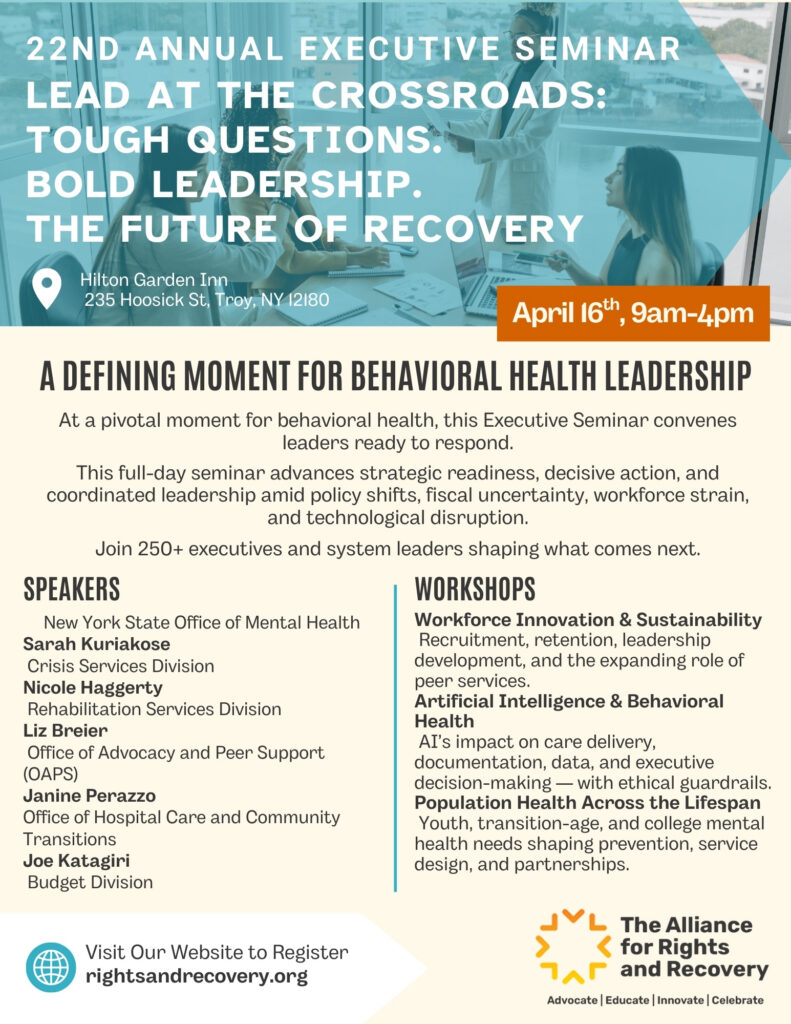
To help providers, advocates, and system leaders navigate this rapidly changing environment, the Alliance for Rights and Recovery is hosting its upcoming Executive Seminar, which will focus on critical state and national policy updates.
At the seminar:
- New York State Office of Mental Health officials will discuss recent budget provisions and the implementation of last year’s investments that continue to be rolled out across the state.
- Alliance staff will provide an overview of key federal policy developments and what they mean for services, funding, and the everyday lives of New Yorkers.
These sessions are designed to equip leaders with the information and context they need to anticipate changes, adapt strategically, and engage in advocacy. As federal priorities evolve, having clear, timely information is essential to protecting access to services and ensuring that recovery-oriented, community-based supports remain strong.
The Executive Seminar will arm system leaders with the knowledge and tools needed to keep their communities healthy, protect critical services, and sustain recovery in the face of ongoing federal policy changes.
Register Today:
2026 Alliance for Rights and Recovery Executive Seminar Tickets, Thursday, Apr 16 from 9 am to 4 pm | Eventbrite
Trump’s SOTU Demands for Congress
By Calen Razor and Mia McCarthy | Politico | February 25, 2026
President Donald Trump littered his record-breaking, nearly two-hour-long State of the Union address last night with dramatic tributes to American heroes, caustic attacks on congressional Democrats and a preview of his party’s midterm campaign pitch.
But he also sprinkled in a handful of legislative demands that have uneven prospects at best on Capitol Hill. Here’s what caught our ears:
— TARGETING NONCITIZENS: Trump repeatedly railed against illegal immigration and pushed lawmakers to pass the SAVE America Act, the GOP bill that would tighten proof-of-citizenship standards for voting.
“Why would anyone not want voter ID?” Trump said at one point. “One reason — they want to cheat.”
But the bigger news might be what Trump didn’t mention: A hard-right push to use a “talking filibuster” to get the House-passed bill past Senate Democrats. In what was likely a big relief for Senate Majority Leader John Thune, the president didn’t mention the filibuster at all. (We have more from Thune on what’s next for the bill below.)
Trump also called for passage of “Dalilah’s Law,” which would bar states from granting driver’s licenses to undocumented immigrants.
— HEALTH CARE: The president pressed Thune and Speaker Mike Johnson to take the most-favored-nation drug-pricing deals he’s recently struck with pharmaceutical companies and enact them into law.
“I’m not sure it matters, because it’s going to be very hard for somebody that comes along after me to say, ‘Let’s raise drug prices by 700 or 800 percent,’” Trump said. “But John and Mike, if you don’t mind, codify it anyway.”
But the provision faces big opposition from the prescription drug industry and its allies inside the GOP.
Completely unmentioned? The expired Obamacare subsidies, which now seem like ancient history in Washington. Trump only briefly mentioned his “Great Health Care Plan” that would give money “directly to the people.”
— STOCK TRADING: Trump drew bipartisan applause after endorsing a ban on stock trading by members of Congress. But getting a bill on Trump’s desk will be tough.
Johnson’s leadership-blessed legislation to crack down on the practice is in limbo, without enough GOP support to put it up for a vote. Democrats are pushing for a more expansive stock trading bill, which would also apply to the president and vice president.
Even if the House can pass something, the Senate is seen as even more unlikely to act.
— CRIME: The president included a demand for lawmakers to pass “tough legislation to ensure violent repeat offenders are put behind bars and, more importantly, that they stay there.”
That called back to Trump’s multiple comments last summer about pursuing a sweeping crime bill, which never materialized into legislation. Rekindling the effort in an election year would be iffy at best.
— HOUSING: Trump renewed his request for Congress to limit large investors from purchasing single-family homes as the GOP tries to address a growing housing affordability crisis — an idea that has bipartisan support.
It comes as the House and Senate are working to reconcile competing legislative packages, and the White House push could help convince skeptical Republicans to include it in a final product.
“We want homes for people, not for corporations,” Trump said.
— LEFT UNMENTIONED: There’s one area where the president conspicuously said lawmakers are free to sit on their hands: “Congressional action will not be necessary,” Trump said, to impose new global tariffs to replace the levies struck down by the Supreme Court last week in what he called a “very unfortunate” ruling.
And while Trump did discuss an expansion of a retirement savings program launched under former President Joe Biden, he did not call for new tax cuts or party-line economic measures to address rising prices — which he continued to blame on Democrats.
“Their policies created the high prices,” he said. “Our policies are rapidly ending them. We are doing really well.”
What Trump’s speech means for DHS talks
Trump’s remarks Tuesday night offered little hope that the two parties can soon reach a deal to reopen the Department of Homeland Security as the shutdown heads into Day 12.
Rather than laying out a path forward in negotiations and inviting Democrats to the table, the president continued to drive a partisan wedge into the DHS funding standoff.
He blamed the opposite party for instituting “another Democrat shutdown” and challenged lawmakers assembled for his address to stand and show their support “if the first duty of the American government is to protect American citizens, not illegal aliens.”
A standing ovation from Republicans followed while Democrats in the room remained seated. Trump then told Democrats they should be “ashamed” of themselves and instructed Congress to pass legislation that would end the more permissive immigration policies of so-called sanctuary cities — a demand Democrats have rejected in DHS negotiations.
Democratic Rep. Adelita Grijalva, who watched the speech from her office, told Meredith Lee Hill that Trump’s move was “a way to pit our communities against each other.”
It was exactly the political dynamic Trump was hoping for, said a top Trump pollster, Tony Fabrizio.
“Ladies and Gentlemen, you just watched live the framing of the 2026 elections,” Fabrizio posted on X. “Take note of who stood and who sat on their hands. Thank you @POTUS.”
Thune prepares for vote on GOP elections bill
Senate Republicans are tentatively planning to bring up the SAVE America voting bill before their next recess at the end of March, Thune told Jordain Carney as he left the Capitol Tuesday night — but only if Congress ends the DHS shutdown first.
Thune also addressed the internal debate over the fate of the legislative filibuster, with some in his conference wanting to skirt the 60-vote hurdle by pushing Democrats to hold the floor via a “talking filibuster.” But many in the GOP fear it would allow Democrats to take control of floor business for potentially weeks or indirectly weaken the supermajority requirement.
Thune told Jordain he hasn’t made a final decision on the process, but he signaled the proposed gambit is short on support right now.
“Our conference is definitely not united on the talking filibuster, and it will take 50 because you’ve got to defeat all the Dem amendments,” he said.
GOP leaders move ahead with House DCA crash legislation
House GOP leaders helped tank a Senate-passed aviation safety bill Tuesday, clearing the way for House committee chairs to move ahead with their own competing proposal on how to address the deadly January 2025 crash at Ronald Reagan Washington National Airport.
GOP leaders didn’t formally whip against the Senate-passed ROTOR Act, which was put on the House floor under an expedited procedure requiring a two-thirds majority vote for passage. But they privately told their members that letting it fail would allow the House to make changes to the legislation — specifically to scale back a provision that would mandate advanced location-receiving technology for planes and helicopters in busy airspace, according to three people granted anonymity to discuss internal conversations.
More than 130 House Republicans ended up voting against it — a major win for House Transportation Chair Sam Graves, who plans to mark up his competing legislation, the ALERT Act, as soon as next week. That bill is more open-ended and has less stringent requirements for aircrafts.
It was a brutal defeat for Senate Commerce Chair Ted Cruz, who crossed the Capitol to join House members on the floor for the final vote, only to see his bill go down in flames. Still, he called the setback a “temporary delay” and said he is “pushing” forward.
“We came within a couple of votes of two-thirds, an overwhelming majority of the House voted for ROTOR,” Cruz told reporters as he walked off the House floor. “I believe we’re going to pass it.”